
When School Strategy Outgrows the Leadership Structure
6 min read
By Stuart Robinson
I remember a college whose direction had changed dramatically. Its Deputy Principal, however, remained committed to a more traditional approach to curriculum design and student discipline.
As time passed, the mismatch became increasingly apparent. This leader was pushing back against the new strategy rather than helping deliver it. Following a difficult conversation with the Principal, the Deputy decided to seek an opportunity more closely aligned with their own preferences.
Rather than simply replacing the departing leader, the college reconsidered its school leadership structure. The single Deputy position became two: one responsible for teaching and learning, the other for pastoral care, or what we would now call wellbeing.
Today, it’s not an uncommon strategic move, but at the time it was relatively unique and innovative.
The main reason was not workload. The college wanted to strengthen both areas to offer students and parents greater value than competing schools. That ambition required different expertise in each portfolio.
The school had not just identified a vacancy. It had identified a different leadership requirement.
Should school strategy fit the people already employed?
I do not believe a school should shape its strategy simply to preserve existing executive portfolios. But neither would I suggest ignoring the capabilities already available. They help us understand what is feasible, what we can build upon, and where investment is needed.
Existing strengths should inform the strategy, but existing positions should not dictate it.
Before concluding that someone no longer fits, I would want to understand the gap. A leader who needs support to develop new skills presents a different challenge from someone who does not want to lead the chosen direction. Neither should be confused with someone raising legitimate concerns about whether the strategy is sound.
AITSL’s Principal Standard and Leadership Profiles explicitly connect professional development with gaps between role requirements and current capabilities. They also describe creating opportunities that develop senior leaders’ talents. That supports development as a starting point, rather than assuming replacement is inevitable.
This connects with my earlier argument that strategic dexterity is a practice, not something automatically acquired through years in leadership.
I would want clear expectations, meaningful support, and an agreed review period. Where the mismatch remains, I would explore suitable alternative work or a respectful transition through the appropriate employment process.
Respecting someone’s contribution does not require pretending that their role must remain unchanged forever.
How much leadership capacity does the strategy require?
Workload still matters.
ACU’s findings from the 2025 Australian Principal Occupational Health, Safety and Wellbeing Survey, released in March 2026, reported average working hours of 53.9 per week. Work volume and insufficient time for teaching and learning were among the leading sources of stress.
However, evidence of overload does not, by itself, tell me which position to create.
Utilising my HR team's skills, I would begin by mapping essential operational responsibilities alongside the work required to deliver the strategy. I would estimate the time and expertise each requires across the school year, including predictable peaks, rather than treating habitual overtime as available capacity.
Consider an illustrative calculation. Suppose the strategy requires 75 hours of leadership attention each week, while existing leaders have 40 hours available after essential operations. That leaves a 35-hour gap.
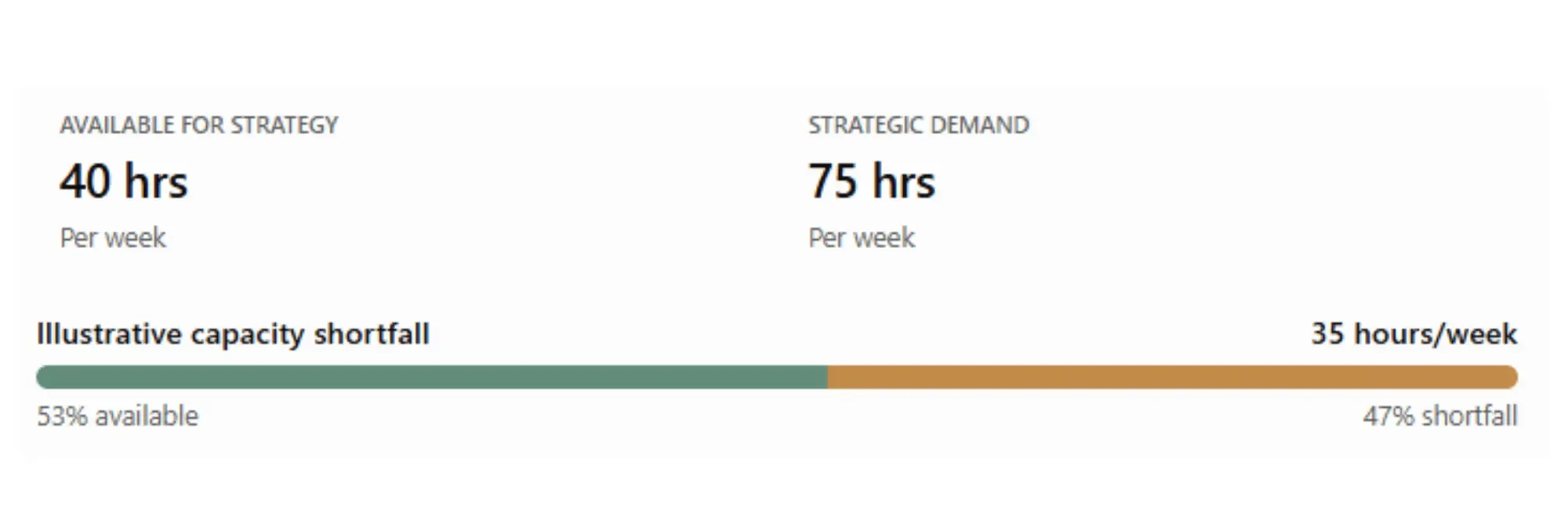
Redesigning processes and genuinely releasing 20 hours would reduce the gap to 15. If a proposed full-time role offered 30 usable hours for this work, that would represent approximately 0.5 full-time-equivalent capacity.
These are modelling assumptions, not staffing benchmarks. Nor does the calculation automatically justify “half a Deputy”. Fifteen fragmented hours without the right expertise may not meet the need.
I would also check that delegated work has not simply overloaded someone else. Only then could I judge whether the answer is additional staffing, different expertise, or a better distribution of responsibility.
Redesign leadership roles before recruiting
Before writing a position description, I would ask what should change in everyone else’s work.
If a new leader becomes accountable for teaching and learning, which responsibilities move from the Principal? What changes for department heads? Which decisions can the new leader make, and which require consultation or approval?
For each affected role, I would identify what stays, what moves, what stops, and what begins.
Adding a leader should change the work, not merely change who attends the meetings.
In the college’s case, separating teaching and learning from pastoral care created distinct portfolios. In designing such an arrangement, I would still want clear coordination at the points where the two intersect, such as student engagement or classroom practice.
Otherwise, I might replace one overloaded position with two overlapping ones.
I would also distinguish an enduring leadership requirement from a temporary implementation challenge. A capability needed intensively for twelve months might justify specialist support rather than another permanent executive position. Conversely, an ongoing strategic capability deserves more than an indefinite patchwork of temporary assistance.
Can fixed-term executive contracts help?
This brings me to the employment arrangements sitting beneath the organisation chart.
Before agreeing to a time-limited executive appointment, I would want one question answered: are we setting a term for the leadership appointment, or for the employment relationship itself? Where an executive has an agreed right to return to classroom teaching, I would treat that as an ongoing staffing commitment to consider from the outset.
For higher-paid executives, fixed-term employment deserves serious consideration. The Fair Work Ombudsman’s guidance confirms that employees whose earnings meet the high-income exception are not subject to the usual two-year limit or associated renewal restrictions. Longer executive contracts are therefore possible under that exception, subject to other applicable requirements. Fair Work Ombudsman
I can see value in executive employment contracts that run for an agreed period without automatically creating a right to return to another position. My interest is not in making leadership employment precarious. It is in creating a deliberate opportunity to reconsider whether the role, its responsibilities, and the expertise it requires still serve the school’s strategy.
That review should begin well before the contract expires. I would want the school and the individual to understand how renewal will be considered, when discussions will occur, and what support or transition arrangements might be appropriate.
I would also obtain specialist employment advice before introducing these arrangements, particularly for existing employees. I would not assume that signing a new leadership contract removes an underlying ongoing appointment or an existing right to return to teaching.
Returning to the classroom may be a sensible outcome where there is a genuine need and an appropriate match. But I would want that commitment to be intentional, rather than an unexamined feature of every executive appointment.
For me, the aim is to give capable leaders sufficient security to lead meaningful change while preserving the school’s ability to reconsider its future leadership needs.
A contract should clarify the employment relationship, not substitute for honest conversations about performance, development, and strategic fit.
A bigger executive team is not the outcome
What I observed after the college appointed its two new Deputies was a change in how the portfolios were led.
Both leaders were more strategic in their approach and developed their teams' skills. There was renewed interest in seeking out strong practice elsewhere, innovating, and trialling ideas that supported the college’s direction.
This was more significant than just creating an additional position.
It was evidence of leadership capability developing around the strategy. It was not, by itself, proof that the intended improvements for students and parents had all been achieved.
As I explored in Business Strategy in Schools: Who Should Be at the Table?, the aim is not to give every portfolio a seat at an ever-expanding table. I would want leaders who bring their expertise to decisions about the whole school, rather than simply advocate for their own areas. Creating separate teaching and learning and wellbeing portfolios should therefore strengthen the school’s ability to deliver a shared strategy, not create two separate agendas. The structure needs to make clear how those leaders contribute, where their authority sits, and how their teams turn strategic choices into practice.
For any proposed restructure, I would want the Principal and Board to agree on the expected contribution, full recurring and transition costs, and when progress will be reviewed. Depending on the strategy, that might include stronger teaching practice, improved student engagement, or more consistent wellbeing support—not simply more projects underway.
The college’s response was to expand its leadership team. Another school might need to redistribute portfolios, strengthen existing leaders, or reduce unnecessary layers.
For me, the starting question remains the same:
If we were designing our school’s leadership structure today, knowing the strategy we intend to pursue, would we create the positions we currently have?
While uncomfortable, the answer may be more beneficial in determining the starting point.

Stuart Robinson
Founder Stuart Robinson brings 25+ years in school business management. With an MBA (Leadership), Bachelor of Business, and AICD graduate credentials, he's highly experienced in helping schools set strategic direction.
Related Posts
When School Strategy Outgrows the Leadership Structure

Principal Succession Planning: What Schools Forget After the Appointment

When ‘The Vibe of the Thing’ Isn’t Enough | Making Better Decisions Under Pressure

How Schools Should Celebrate Earned Wins
